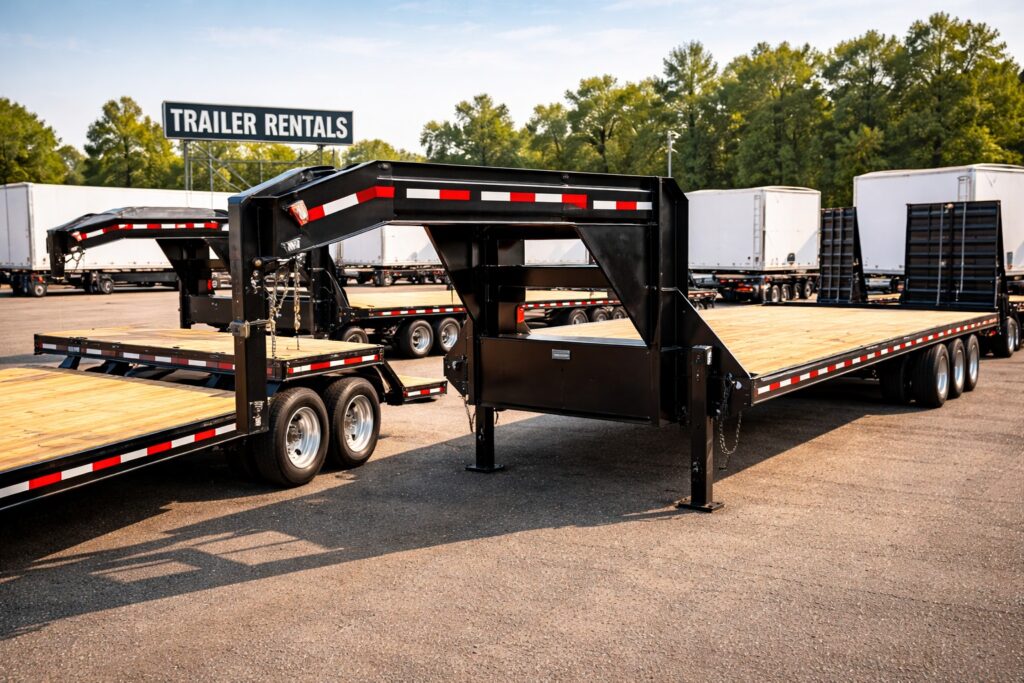
Gooseneck trailer rentals vary a lot in both price and quality. The biggest price drivers are trailer length, payload, ramp or dovetail style, and the level of support the rental company provides. In most real listings, small or lighter-duty goosenecks sit near the low end, while longer contractor-grade units with higher capacity and better loading features cost more.
How much do gooseneck trailer rentals usually cost?
Most gooseneck trailer rentals land between about $140 and $225 per day, but that range only tells part of the story. A short 25-foot unit with lower capacity can rent near $140 per day, while a 40-foot contractor-grade trailer with mega ramps and stronger hauling specs can reach $225 per day.
Here is what current listings usually look like:
| Rental type | Example | Listed price |
|---|---|---|
| Light to mid-duty gooseneck | 25 ft superwide gooseneck deckover, 5-ton load capacity | $140/day + tax |
| Basic local gooseneck rental | Generic gooseneck trailer listing | $150/day, $500/week, $1,500/30 days |
| Mid-range heavier unit | 32 ft gooseneck trailer, 25K rating | $175/day, $700/week, $2,100/month |
| Another local heavier unit | Generic gooseneck trailer listing | $200/day, $1,500/28 days |
| Contractor-grade longer unit | 40 ft gooseneck with mega ramps | $225/day, $1,350/week |
That pricing pattern matters because renters often compare daily rates without comparing the trailer itself. A $140 unit and a $225 unit may not compete in the same class. One may handle lighter equipment and shorter hauls, while the other may save time on loading, offer more tie-down flexibility, and support heavier work.
Why do some gooseneck rentals cost much more than others?
Higher-priced gooseneck rentals usually cost more because they offer more capacity, better loading hardware, and more job-ready features. The extra money often pays for longer decks, mega ramps, hydraulic dovetails, stronger axles, better brakes, and hardware that makes loading and securement faster and safer.
A good example shows up in real listings. A 25-foot superwide gooseneck may list for $140 per day, with a 5-ton load capacity, 7K axles, electric brakes, and mega ramps. A 40-foot unit may list at $225 per day and add a much longer deck, a low-profile setup, 15,800-pound load capacity, mega ramps or slide-in ramps, and unlimited tie-down points. Those are very different tools for very different jobs.
Longer rentals can also improve the value picture. Many rental companies lower the daily equivalent when you move from a single day to a weekly or monthly rate. That means the best price often depends on rental length, not just trailer size.
Does a higher rental price usually mean better quality?
A higher price often means better capability, but it does not always mean better quality. Real quality shows up in the trailer’s condition, maintenance, brakes, coupler, deck design, loading angle, and securement setup. A clean, well-maintained mid-range trailer can outperform a more expensive unit that does not fit the load.
When you compare quality, look for details like these:
- Electric brakes on both axles
- Breakaway kit
- Strong coupler and landing gear
- Ramp style or hydraulic dovetail
- Reasonable loading angle
- Winch track or strong tie-down points
- Payload and GVWR that match the job
- Tires, wiring, lights, and deck condition
Those features affect real-world use more than paint, brand hype, or a glossy photo. Some higher-end models include self-adjusting electric brakes on both axles, a breakaway system, a sliding winch track, and a cleated dovetail. Others offer a hydraulic dovetail with high load capacity and a low ramp angle. Features like that improve the rental experience by reducing loading stress and eliminating headaches.
What should renters check before choosing the cheapest gooseneck trailer?
Renters should check whether the cheapest trailer actually fits the load, tow vehicle, and route. A low daily rate can turn into a bad deal if the trailer lacks payload, ramps, brakes, or the right deck length. Cheap only helps when the trailer can do the job without slowing you down.
Before renting, check these points:
- Towing capacity of the truck
- Hitch and coupler match
- Brake controller requirements
- Cargo weight
- Cargo dimensions
- Axle setup
- Deck length
- Ramp or dovetail design
- Trailer condition
That advice matters even more with goosenecks because these trailers often carry heavier machines, materials, or vehicles. If the trailer is too small or too light, the lower rate will not save the job.
Which rental option gives the best value?
The best value usually comes from the trailer that matches the work without overspending on unused capacity. For lighter jobs, a lower-cost 25-foot unit may offer strong value. For equipment hauling, hotshot work, or low-clearance machines, a longer trailer with better ramps or a hydraulic dovetail often delivers better value even at a higher rate.
In plain terms, the best-value rental usually looks like this:
| Job need | Best value choice |
|---|---|
| Light equipment or shorter hauls | Smaller gooseneck with basic ramps and electric brakes |
| Medium equipment and frequent local moves | 30 to 32 ft unit with 20K to 25K rating |
| Heavy equipment, hotshot work, or repeated loading | 35 to 40 ft low-profile unit with mega ramps or hydraulic dovetail |
That is why price and quality should always be compared together. A $140 trailer may beat a $225 trailer for a simple short-haul move. But if the heavier trailer saves an hour of loading, handles the machine more safely, and reduces tie-down trouble, the higher rate can still be the smarter buy.
What is the bottom line on gooseneck trailer rental price and quality?
Gooseneck trailer rentals compare best when you judge them by class, not by headline rate alone. Lower-cost rentals work well for lighter loads and shorter jobs. Higher-cost rentals usually justify the price with better capacity, better loading hardware, and more secure hauling features. The best rental is the one that fits the job cleanly and safely.